
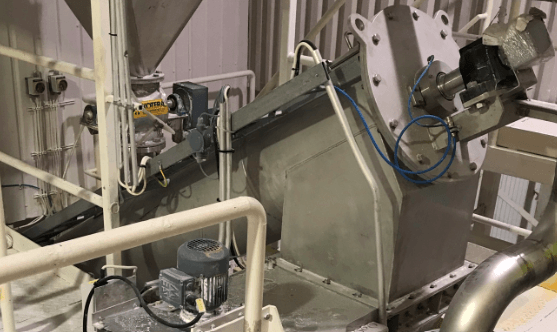
What is a screw conveyor?
A screw conveyor is a mechanical device that transports materials using a rotating screw inside a tube or trough. Its operating principle is based on Archimedes' screw: as the screw rotates, its threads push the material forward in the direction of the shaft. This simple yet effective mechanism is suitable for a wide range of industrial applications – from mining to the chemical industry, and from waste management to biogas plants. In this article, we will cover the operating principle of the screw conveyor, the most common types, selection criteria, structural features, as well as maintenance and design principles.
Screw conveyors are particularly valued for their versatility: the same basic structure can be adapted to handle a wide variety of materials and process conditions. A correctly sized and designed system is an energy-efficient, reliable, and long-lasting investment.
Screw conveyor working principle
The screw conveyor is based on the Archimedes screw, one of the oldest known mechanical devices. As the screw rotates, it moves material forward inside a pipe or chute. This movement is caused by friction between the threads of the screw and the walls of the pipe.
The speed and capacity of a screw conveyor depend on several factors, such as the diameter of the screw, the pitch of the threads and the rotation speed. These parameters can be adjusted as needed to achieve the desired transfer power and speed.
Screw conveyor types and their suitability for different applications
Screw conveyors are not a one-size-fits-all solution – different applications require different structural solutions. The type of screw conveyor is primarily chosen based on the properties of the material to be conveyed, the installation environment, and process requirements. The following describes the most common types and their typical applications.
Grain conveyor
A trough screw conveyor is a screw conveyor based on an open trough structure, where the screw rotates inside a U-shaped trough. It is best suited for dry, free-flowing materials such as grain, sand, ash, or granular chemicals. The open structure facilitates cleaning and allows material to be added or removed from multiple points along the conveying path. A limitation of the trough screw conveyor is its unsuitability for dusty, moist, or hazardous materials that require a closed system for handling.
Pipe conveyor
The tubular conveyor is a screw conveyor based on a closed tubular structure, where material is transported completely isolated from external conditions. This type of screw conveyor is particularly well-suited for dusty, damp, hazardous, or easily perishable materials. The closed structure prevents the material from spreading into the environment and simultaneously protects it from external moisture and contaminants. The tubular conveyor is a common choice in the chemical industry and in processes with strict environmental requirements.
Horizontal screw conveyor
A horizontal screw conveyor is a basic solution for flat material transfer between two points. It is simple in construction, easy to size, and suitable for a wide range of materials and industries. Due to its horizontal installation, the conveyor's capacity is typically at its maximum, and energy consumption remains controlled. It is often the starting point against which other conveyor solutions are compared.
Inclined and vertical screw conveyor
An inclined screw conveyor allows material to be moved between different heights without a separate lifting device, making it an efficient solution for space-saving or processes involving height differences. As the installation angle increases, the conveyor's capacity typically decreases, and the risk of material flowing backwards must be considered in the design. A vertical screw conveyor takes up the least floor space and is particularly suitable for silo filling and multi-level plant structures. The flow characteristics of the material play a particularly key role in the dimensioning of these conveyor types.
Flexible screw conveyor
A flexible screw conveyor consists of a flexible tube and a flexible screw rotating within it, allowing material to be transported through winding or tight routes. It is particularly suitable for situations where a fixed structure is not possible or where the transport route changes during the process. The limitation of a flexible screw conveyor is typically its lower capacity and shorter maximum conveying distance compared to fixed-structure alternatives.
How to choose the right screw conveyor for your process needs?
Choosing the right screw conveyor is one of the most crucial decisions in bulk materials handling design. An incorrect choice can easily lead to excessive wear, capacity issues, or unnecessarily high operating costs. It is advisable to start the selection process systematically by assessing the process requirements from several different perspectives.
Properties of movable material
The material properties are the most important single factor in the sizing and type selection of a screw conveyor. Key factors to consider include particle size and distribution, bulk density, moisture content, abrasiveness, and the material's tendency to stick or form bridges. Chemical properties, such as corrosiveness or reactivity, in turn affect the material choices for the conveyor structure. For example, highly abrasive materials require hardened or coated screws and a trough structure protected against wear.
Capacity and speed requirements
The required throughput – meaning how much material needs to be conveyed per unit of time – largely determines the screw diameter and rotational speed. It is important to consider both average and peak throughput so that the system does not become a bottleneck in the process. Conversely, too high a rotational speed can cause material degradation or excessive wear, so an optimal balance between speed and throughput must be found on a case-by-case basis.
Installation environment and conditions
The available space, transport distance and installation angle significantly limit the selection of suitable conveyor types. Furthermore, environmental conditions – such as operating temperature, humidity, risk of explosion, or exposure to chemicals – must be taken into account when selecting materials as well as seals and joints. A conveyor operating outdoors or under demanding process conditions requires a different level of protection than a basic indoor system.
Material choices for the conveyor structure
The material selection for a structure is always made based on the material to be conveyed and the environmental conditions. Standard structural steel is sufficient for many dry and non-corrosive applications, but moist, acidic, or chemically active materials require stainless or acid-resistant steel. In abrasive applications, screw coating or hardening treatment significantly extends the service life of components and reduces maintenance needs.
Long-term operating and maintenance costs
The purchase price is only part of the total cost of a conveyor. Energy consumption, spare parts costs, maintenance intervals, and potential downtime costs often make up a more significant portion of the lifecycle costs. A well-designed and correctly sized system will pay for itself through lower energy consumption and reduced maintenance needs – therefore, it is worth investing sufficient time in the conveyor selection during the design phase.
Advantages of the screw conveyor
Screw conveyors offer several advantages over other material handling equipment. Firstly, they are highly efficient and can move large quantities of material quickly and reliably. This makes them ideal for use in industrial environments where material flows are high.
Secondly, screw conveyors are closed systems, which reduces material waste and dust. This is particularly important when handling fine or hazardous materials. The closed design also protects the material from external factors such as moisture and contamination.
Screw conveyor applications
Screw conveyors are widely used in various industries. In the mining industry, they are indispensable for the transport and handling of ores, rocks and minerals. In the chemical industry, screw conveyors are indispensable for conveying chemical powders and raw materials.
In waste management and recycling, screw conveyors are effective in transferring and handling solid waste, such as compost and recyclables. They are also commonly used in biogas plants, where they feed biomass into biogas reactors.
Structural characteristics of the screw conveyor
The screw conveyor is made up of several key components. These include the screw, the tube or chute, the motor and the bearings. The screw is usually made of durable steel and its threads can be either continuous or discontinuous, depending on the application.
The pipe or chute in which the screw moves can be made of different materials, such as steel, stainless steel or plastic. A motor rotates the screw, and bearings support the screw and reduce friction. Together, these components form an efficient and durable system for moving materials.
Screw conveyor maintenance and servicing
Regular maintenance and servicing are essential for the efficient operation of a screw conveyor. This includes checking the screw and tube for wear, lubricating the bearings and checking the condition of the motor. Regular maintenance helps ensure that the screw conveyor is operating optimally and reduces the risk of unexpected downtime.
It is also important to check the alignment and balance of the screw conveyor. An unbalanced or misaligned screw can cause extra wear and damage to the system. Therefore, it is recommended to perform regular checks and adjustments as needed.
Screw conveyor design and customisation
The design and customisation of a screw conveyor are key factors in its efficiency and suitability. Each application is unique, and a screw conveyor must be designed to meet specific needs. This can include customization of screw diameter, thread pitch, material and other parameters.
A customized screw conveyor can improve process efficiency and reduce operating costs. It is important to work with expert designers and engineers to ensure that the screw conveyor meets all requirements and performs optimally.
Expert design as the foundation of process efficiency
We have observed that the starting point for successful bespoke material handling is always a thorough understanding of the customer's process – not just meeting technical specifications. Material properties, capacity needs, and environmental conditions must be analysed as a whole before any sizing decisions are made. In our experience, a correctly designed system significantly reduces unplanned downtime and extends equipment lifespan – both factors that have a direct impact on the overall process costs. In demanding industrial conditions, this precision in process design is often the crucial difference between a functioning and an underperforming system.
Environmental impact and sustainability
Screw conveyors can also have an impact on the environment and sustainability. A closed system reduces dust and material waste, which is good for the environment. In addition, screw conveyors can be energy efficient, reducing their carbon footprint.
It is important to choose the right materials and components that last a long time and are recyclable. This will help reduce your environmental impact and promote sustainable development. The design and use of a screw conveyor must take into account the environmental impact and aim to minimise it.
Summary
Screw conveyors are versatile and efficient devices that are indispensable in many industrial processes. Their operation is based on a simple but efficient mechanism that allows materials to be moved quickly and reliably. The design, maintenance and environmental impact of a screw conveyor are key factors in its efficiency and durability.

You have a challenge that needs solving?
Let us help! Contact us for more information about our products and services.