

MECHANICAL CONVEYORS/FORGED CONVEYOR CHAINS
Forged conveyor chains for hot and abrasive processes
In the conveyors of the heat recovery boilers of the smelters, the chain operates under constant tensile load, high temperature and often under an impact load of material. Under such conditions, design, material selection and sizing are of crucial importance.
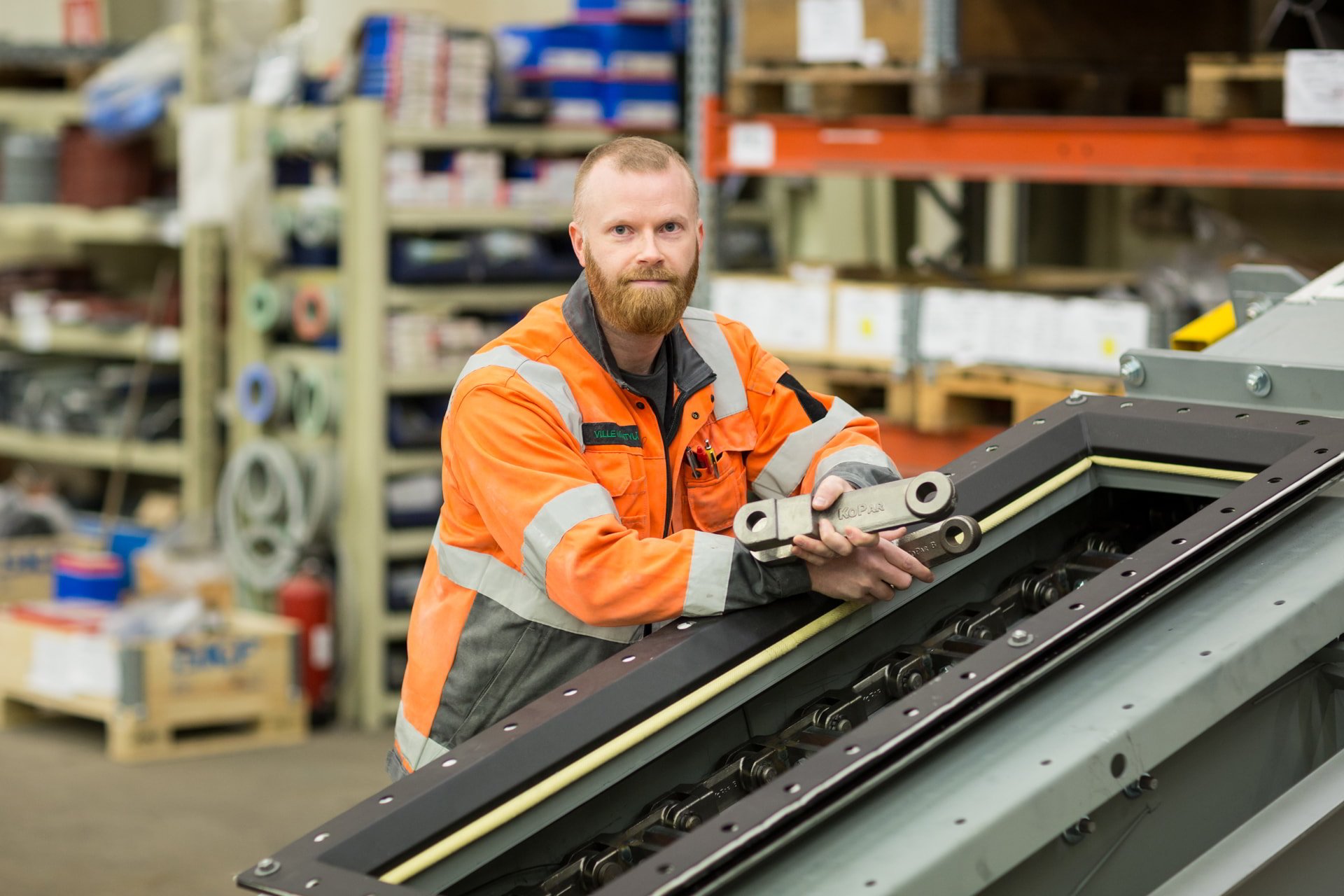
Kopar's boron steel 216W-forged chains are designed for these conditions of use. We have been supplying wear-resistant forged link chains to metal processing plants for decades. Our chains are manufactured in Finland.

Why choose the Kopar chain?
Protected structure reduces deformation
In smelting and boiler applications, the material being transported often contains large and irregular growths. If material falling from the boiler, such as vegetation, hits the chain directly, the result can be permanent deformation of the links, deterioration of chain alignment and particularly heavy wear.
Kopar's solution combines a rigid 216W roller chain design with a conveyor design that prevents the material from hitting the chain directly. The design of the conveyor can be modified and improved at different stages of its life cycle to distribute the load more evenly and control wear more easily.
Improved wear life extends service life
The chain links are heat treated to improve their surface hardness and thus their resistance to wear. During the heat treatment, i.e. hardening, boron steel behaves differently from manganese steel, not only hardening on the surface but also hardening almost all the way through, making the link tough and therefore particularly resistant to wear.
According to our tests, the surface hardness of boron steel at room temperature is about 30% higher than that of manganese steel. At high temperature the difference becomes more pronounced, increasing up to 70%.

Higher breaking strength at elevated temperatures
The tensile strength and surface hardness of steel decrease with increasing temperature.
The 216W chain is larger than the commonly used 142V chain and has a much higher nominal breaking strength. The larger cross-sectional area means greater tensile load resistance, even in situations where temperature deteriorates the properties of the material.
Kopar chain links are made of boron steel. Boron steel retains its mechanical properties at elevated operating temperatures better than typical manganese steel. This improves reliability under continuous load and extends the service life.
Controlled temperature prevents corrosion
If the internal temperature of the conveyor falls below the acid dew point, sulphuric acid can form in the process gases. This accelerates corrosion and shortens the life of the chain and conveyor structures.
The design of the chains takes into account insulation and temperature control so that the internal temperature remains above the dew point. The chain material and dimensions are selected based on actual operating conditions.
Tightness is maintained even during thermal expansion
High operating temperatures cause significant thermal expansion in conveyor structures. If thermal movements are not taken into account, gaps, dust leaks and additional maintenance will occur.
Conveyor structures are designed so that thermal movements are controlled and tightness is maintained over the entire operating range. The chain and housing structure form a functional unit, which improves process safety and reduces material loss.


216W - a robust chain for demanding conditions
The 142V chain link type is a typical solution for demanding applications, but with a continuous operating temperature of up to about 200 °C.
In contrast, Kopar's 216W chain link is designed for higher load and temperature applications where continuous operating temperatures can range from 300-400°C.
216W - for demanding conditions
The more rigid 216W offers higher breaking load and a higher safety margin, especially in waste heat boilers, gas cooling boilers, heat recovery boilers and in general in drag chain conveyors for metallurgical smelters.
When replacing the chain, we always recommend that you replace the sprockets at the same time to ensure the conveyor works properly.

When is a basic solution enough?
When the process is not subject to significant temperature stresses and the current service life is sufficient, a smaller link size and even a manganese steel chain may be justified.
Where temperature and constant load limit service life, the boron steel 216W forged conveyor chain is technically a more durable option.

Comparison of 142V and 216W chain link types
| Type of link | Nominal tensile strength | Operating temperature range |
|---|---|---|
| 142V | 520 | Max 200 °C |
| 216W | 750 | 300-400 °C |
Choose 216W and you will get
at least 44% more tensile strength
The chain as part of the overall conveyor system
The life of a chain is not determined by the material alone. Thermal expansion, insulation, load distribution and chain protection have a decisive influence on the performance of the chain as a whole.
Kopar looks at the chain as part of the whole conveyor. Replacement chain deliveries also include an assessment of operating conditions and sizing before a final recommendation is made.
If required, chains can also be made from special materials to suit the application.
We can also provide you with chain replacement work if required.

Request a quote or talk to an expert
Go to the product configurator and specify your own chain solution or contact our experts directly. We'll help you choose a solution that can withstand the real conditions of your process.