

The conveyor chains at smelters operate in extremely demanding conditions where corrosion can destroy expensive components surprisingly quickly. Maintenance managers often find themselves in a situation where newly replaced chains reach the end of their service life sooner than expected. By understanding the causes and mechanisms of corrosion, better material choices and design solutions can be made. Forged conveyor chains require special attention in metallurgical processes, where temperature, chemical compounds, and mechanical stress combine to form a challenging whole.
Corrosion is not merely a surface phenomenon, but a complex process that accelerates exponentially under certain conditions. In foundries, these conditions are met almost perfectly, making the understanding of corrosion critically important in optimising the lifespan of chains.
What is corrosion and why does it particularly affect conveyor chains in foundries?
Corrosion is the chemical or electrochemical reaction of metals with their environment, which degrades the material's structure and properties. In the conveyor chains of foundries, corrosion is accelerated by the combination of high temperatures, aggressive gases, and mechanical stress.
In metallurgical processes, corrosion differs significantly from standard rusting. When steel is simultaneously exposed to high temperatures and acidic compounds, oxidation reactions accelerate dramatically. Sulphur dioxide and water vapour, in particular, can combine to form sulphuric acid, which effectively corrodes steel structures.
When it comes to conveyor chains, the corrosion problem is multiplied because the chain is in constant motion and subject to continuous wear. The chain joints and contact surfaces are particularly susceptible to corrosion.
Mitkä ympäristötekijät sulatoissa nopeuttavat kuljetinketjujen korroosiota?
In the environment of a furnace, corrosion is primarily accelerated due to temperature fluctuations, the acid dew point, and aggressive process gases. The temperature range of 250–400°C is critical, as within this range, chemical reactions significantly speed up while the material's protective properties diminish.
The formation of the acid dew point is one of the most serious corrosion risk factors. When the internal temperature of the conveyor drops below 120–140°C, sulphur dioxide and water vapour in the process gases condense to form sulphuric acid. This acid is particularly aggressive towards steel and can destroy chain structures within a few months.
The composition of process gases has a decisive impact on the corrosion rate. Sulphur compounds, chloride ions, and particulate matter act as catalysts that accelerate oxidation reactions. In particular, metal salts contained in copper smelter dust can cause galvanic corrosion, where different metals form an electric couple and accelerate each other’s degradation.
Moisture is another critical factor. Although the smelting processes are hot, temperature fluctuations can cause condensation on the conveyor walls. This moisture, along with process gases, creates ideal conditions for corrosion, particularly in the colder parts of the conveyor and during downtime.
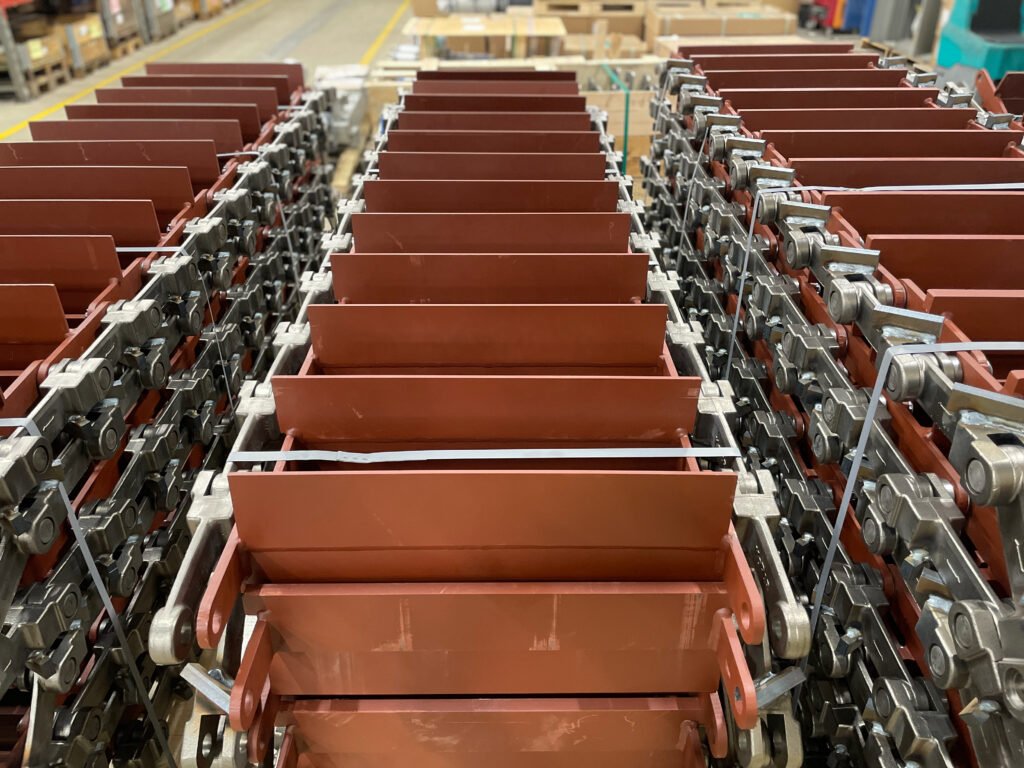
Mekaaninen rasitus ja kuluminen edistävät korroosiota kuljetinketjuissa usealla eri tavalla. Nämä ilmiöt luovat epätasaisia ja vaurioituneita pintoja, joihin korroosio voi tarttua ja edetä helpommin kuin ehjälle pinnalle. Tässä tarkemmin, miten ne vaikuttavat: * **Pinnan epätasaisuuksien muodostuminen:** * **Mekaaninen rasitus:** Jatkuva kuormitus,Iskut ja tärinä voivat aiheuttaa ketjun lenkkien ja rullien kuormituspisteisiin mikroskooppisia muodonmuutoksia ja väsymismurtumia. Nämä pienet vauriot, halkeamat tai kohoumat rikkovat metallin yhtenäisen suojaavan oksidikerroksen. * **Kuluminen:** Hankaava kuluminen, joka johtuu esim. ketjun ja ohjainten tai muiden ketjun osien välisestä vuorovaikutuksesta, poistaa metallipintaa. Tämä kuluminen luo karheita ja epätasaisia pintoja. * **Oksidikerroksen rikkoontuminen:** * Metalli muodostaa luonnostaan suojaavan oksidikerroksen ilman ja kosteuden kanssa. Mekaaninen rasitus ja kuluminen voivat mekaanisesti rikkoa tai poistaa tämän kerroksen paljastaen alla olevan, reaktiivisemman metallin. Paljaan metallin pinta on huomattavasti alttiimpi kemiallisille reaktioille, jotka johtavat korroosioon. * **Korroosiopesäkkeiden muodostuminen:** * Rikkinäiset tai kuluneet kohdat ovat ihanteellisia paikkoja korroosiolle aloittaa. Erityisesti jännityskorroosiota esiintyy helpommin alueilla, joissa on jännitystä ja pinnan vaurioita. * Mekaaninen rasitus voi luoda jännityskonsentraatioita ketjun osiin, ja yhdessä pinnan epätasaisuuksien kanssa nämä alueet ovat alttiimpia erilaisille korroosiomekanismeille, kuten pistekorroosiolle tai rakokorroosiolle. * **Voiteluaineiden poistuminen ja lian kertyminen:** * Kuluminen voi poistaa voiteluaineita ketjun liukupinnoilta, mikä lisää kitkaa ja nopeuttaa edelleen kulumista ja vaurioiden syntymistä. * Epätasaiset ja vaurioituneet pinnat keräävät helpommin likaa, pölyä ja muita epäpuhtauksia. Nämä epäpuhtaudet voivat pidättää kosteutta ja kemikaaleja, jotka edistävät korroosiota. Ne voivat myös toimia sähkökemiallisina kennoina, jotka nopeuttavat korroosiota. * **Galvaaninen korroosio:** * Jos ketju on valmistettu kahdesta eri metallista, tai jos pinnoite vaurioituu ja paljastaa eri metallin, mekaaninen rasitus ja kuluminen voivat nopeuttaa galvaanista korroosiota. Ero metallien sähköpotentiaalissa johtaa siihen, että vähemmän jalostunut metalli syöpyy aktiivisemmin. Yhteenvetona, mekaaninen rasitus ja kuluminen toimivat yhdessä luomalla ketjun pinnalle haavoittuvuuksia, jotka poistavat suojaavia kerroksia, edistävät epäpuhtauksien kertymistä ja tarjoavat ihanteellisia aloituskohtia korroosion kemiallisille reaktioille.
Mechanical stress and corrosion create a synergistic effect in chains, where each phenomenon significantly accelerates the other. Continuous loading and movement remove protective oxide layers, exposing fresh metal to corrosion, while corrosion weakens the material's mechanical properties.
The joints of conveyor chains are particularly susceptible to this combined effect. As the chain runs over the sprockets, microscopic cracks and scratches form on the contact surfaces. These defects act as initiation points for corrosion, allowing aggressive compounds to penetrate the material.
Abrasive wear further exacerbates the situation. Hot and coarse material build-ups constantly grind the surface of the chain, which keeps the metal surface active for corrosion. Particularly in situations where excessively large material pieces enter the conveyor, impact loads can cause local stress peaks that accelerate the progression of corrosion.
Thermal shock is another significant cause of mechanical stress. When hot lumps fall onto the chain, the sudden rise in temperature causes uneven expansion and internal stresses. These stresses can open existing microcracks and create new pathways for corrosion to advance.
How can corrosion problems be prevented in the transport systems of smelters?
Preventing corrosion problems requires a holistic approach, combining correct material selection, temperature control, structural protection, and optimised operating parameters. The most effective protection is achieved by controlling the operating temperature between 250–400°C and choosing boron steel chain materials for demanding conditions.
Material selection is of paramount importance. Traditional manganese steel (20MnCr5) performs well at temperatures below 200°C, but in hotter and more corrosion-prone conditions, boron steel (27MnCrB5) offers significantly better performance. Boron steel's surface hardness is maintained at higher temperatures, and its corrosion resistance is considerably better.
Temperature control is critical in the prevention of corrosion. The internal temperature of the conveyor should be kept sufficiently high to avoid the acid dew point, but not so high that it degrades the mechanical properties of the chain. Careful insulation and thermal compensation ensure a uniform temperature distribution and prevent condensation.
Structural protection can significantly reduce both mechanical wear and the risk of corrosion. Chain guards must protect against both radiant heat and material impact. Particle size control before the conveyor prevents damage caused by overly large pieces and thermal shock.
Optimising operating parameters is crucial for chain longevity. The transport speed should be kept as low as possible, as wear increases exponentially with speed. This also applies to the corrosion rate, which accelerates with mechanical stress.
Regular maintenance and monitoring are essential for the early detection of corrosion. The condition of the chain should be assessed regularly, especially at critical points such as sprockets and conveyor passages.
Maintenance managers should consider Stainless steel rear tow chains implementation, should the current chains wear out faster than expected. Although the investment costs are higher, the longer lifespan and reduced maintenance needs compensate for the initial expenses. Corrosion prevention is always more cost-effective than repairing its consequences, and the right material choices and design solutions can double the lifespan of chains in demanding smelter conditions. Contact us to determine how the performance of your process conveyor chains could be improved.
Read more about sustainable from taco chains.
You have a challenge that needs solving?
Let us help! Contact us for more information about our products and services.