
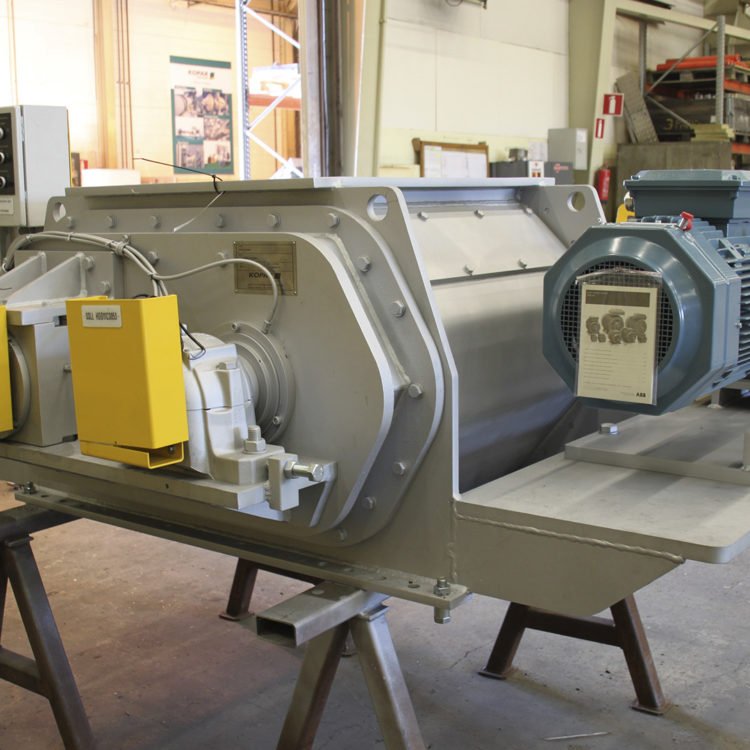
What are crushers?
Crushers are an integral part of industrial material handling, and their primary function is to crush or reduce the size of the material to facilitate further handling or transport. They are widely used in a variety of industries, including mining, construction and recycling. Crushers are particularly important when large quantities of solid material need to be processed into a more usable form.
By making the material handling process more efficient, crushers help optimise the efficiency of production lines and reduce energy consumption. This is particularly important in industry, where saving resources and reducing environmental impact are key objectives. Crushers are often used in combination with other material handling equipment, enabling seamless and efficient process integration.
How do crushers work?
The operating principle of a crusher is usually based on the mechanical force used to compress, cut or impact a material to reduce its size. The main types of crushers are jaw, cone and hammer crushers, each with its own characteristics and uses. Jaw crushers are particularly suitable for processing hard and abrasive materials, while cone crushers offer an efficient solution for crushing finer material.
Hammer crushers, on the other hand, use rotating hammers that crush the material by impact. This type is particularly effective for processing soft and medium-soft materials. Each type of crusher is designed for specific applications, which underlines the importance of the right choice of crusher for optimum efficiency. The choice of crusher depends on the characteristics of the material to be processed, such as its hardness and moisture content.
Practical applications of crushers
Crushers are widely used in the mining industry, where they are an essential part of ore extraction and processing. They help to reduce the size of large aggregates, making them easier and more economical to transport and process. In the construction industry, crushers are essential for waste recycling, as they can efficiently convert construction waste into reusable materials.
In the recycling sector, crushers play an important role, especially in the recovery of metals and other valuable materials. Crushers can handle large volumes of waste and can be used to isolate and recycle different materials in an efficient and environmentally friendly way. This contributes to the circular economy and reduces the amount of waste going to landfill, which is important for achieving the Sustainable Development Goals.
Common challenges in the use of crushers
Although crushers are efficient at handling materials, there can be challenges in their use. One of the most common problems is wear and tear, which can affect the performance of the crusher and shorten its lifespan. However, wear can be reduced through regular maintenance and the selection of the right materials. Material moisture can also cause problems, as excessively moist material can clog the crusher or reduce its efficiency.
The second challenge is the power and capacity of the crusher, especially when handling large amounts of material. Choosing the right crusher and integrating it into the system are crucial factors in overcoming these challenges. Appropriate training and guidance for staff can also improve the use of the crusher and reduce problems of misuse.
Crushers compared to other methods
When compared to other material handling methods, such as grinding or cutting, crushers have the advantage of being able to process large quantities of material efficiently and quickly. Crushers are particularly useful when the material is hard or bulky and requires high force. This makes them ideal for primary material handling where a high-capacity solution is required.
On the other hand, there are also limitations to the use of crushers. They may not be as suitable for handling fine materials as, for example, grinding techniques. When selecting crushers, it is important to assess the characteristics of the material to be processed and to choose the right method for each application. This will ensure that material handling is as efficient and economical as possible, which in turn will support the optimisation of industrial processes and sustainable development objectives.
You have a challenge that needs solving?
Let us help! Contact us for more information about our products and services.